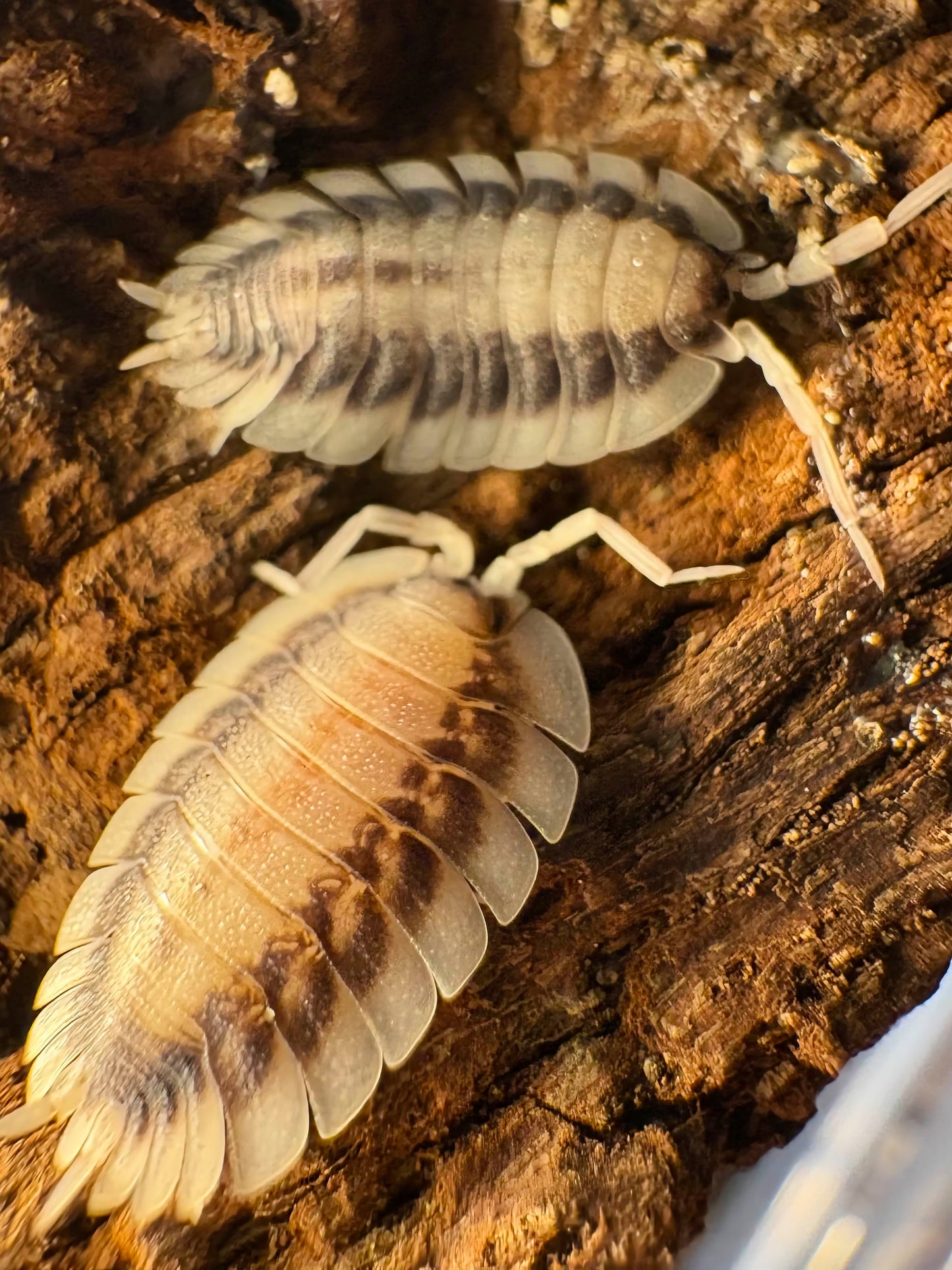
Porcellio werneri "Silverback"
This is a distinctive line known as “Silverback”, originating from a separate wild population than the typical grey Porcellio werneri. Individuals from this population display a broad, silvery-white stripe running down the centre of the body giving them a striking appearance. They retain the same large size and extremely broad, flat body shape characteristic of Porcellio werneri.
These isopods are captive-bred (CB).
Care Information
- Size: Mixed sizes.
- Diet: Rotting hardwood, leaf litter (oak, beech, maple, chestnut, Asian species), and lichen form the staple diet. Supplement regularly with calcium (cuttlefish bone, limestone, or powdered calcium carbonate), protein-rich treats (fish flakes, shrimp pellets) and vegetables (squash, carrot, zucchini, or sweet potato).
- Temperature: 20–28 °C.
- Humidity: 40-50%. Requires low humidity. Maintain a moist/dry gradient: 1/4 of the tub humid with moss or damp substrate, the remaining drier. Mist lightly or use a dropper every week to maintain stability without waterlogging.
- Ventilation: Provide good cross-ventilation to prevent stagnation, while keeping humidity stable.
- Substrate: Substrate minimum ~5cm deep mix, organic soil, flake soil, rotting wood, sphagnum moss, and leaf litter. Add cork bark and hardwood pieces for shelter.
- Enclosure: 3L Braplast tub or larger. For growing colonies 5L and 11L tubs may be more suitable.
Isopods are shipped securely in ventilated tubs with damp moss for safe travel.
Note: If you are interested in larger quantities than those listed, or want any advise, please get in contact!
Species Info
 Greece
 Porcellio
 Werneri "Silverback"
 Mixed sizes
 20 - 28 °C
 40 - 50%
 High
High
Buy Now
Couldn't load pickup availability
Porcellio werneri "Silverback"
This is a distinctive line known as “Silverback”, originating from a separate wild population than the typical grey Porcellio werneri. Individuals from this population display a broad, silvery-white stripe running down the centre of the body giving them a striking appearance. They retain the same large size and extremely broad, flat body shape characteristic of Porcellio werneri.
These isopods are captive-bred (CB).
Care Information
- Size: Mixed sizes.
- Diet: Rotting hardwood, leaf litter (oak, beech, maple, chestnut, Asian species), and lichen form the staple diet. Supplement regularly with calcium (cuttlefish bone, limestone, or powdered calcium carbonate), protein-rich treats (fish flakes, shrimp pellets) and vegetables (squash, carrot, zucchini, or sweet potato).
- Temperature: 20–28 °C.
- Humidity: 40-50%. Requires low humidity. Maintain a moist/dry gradient: 1/4 of the tub humid with moss or damp substrate, the remaining drier. Mist lightly or use a dropper every week to maintain stability without waterlogging.
- Ventilation: Provide good cross-ventilation to prevent stagnation, while keeping humidity stable.
- Substrate: Substrate minimum ~5cm deep mix, organic soil, flake soil, rotting wood, sphagnum moss, and leaf litter. Add cork bark and hardwood pieces for shelter.
- Enclosure: 3L Braplast tub or larger. For growing colonies 5L and 11L tubs may be more suitable.
Isopods are shipped securely in ventilated tubs with damp moss for safe travel.
Note: If you are interested in larger quantities than those listed, or want any advise, please get in contact!