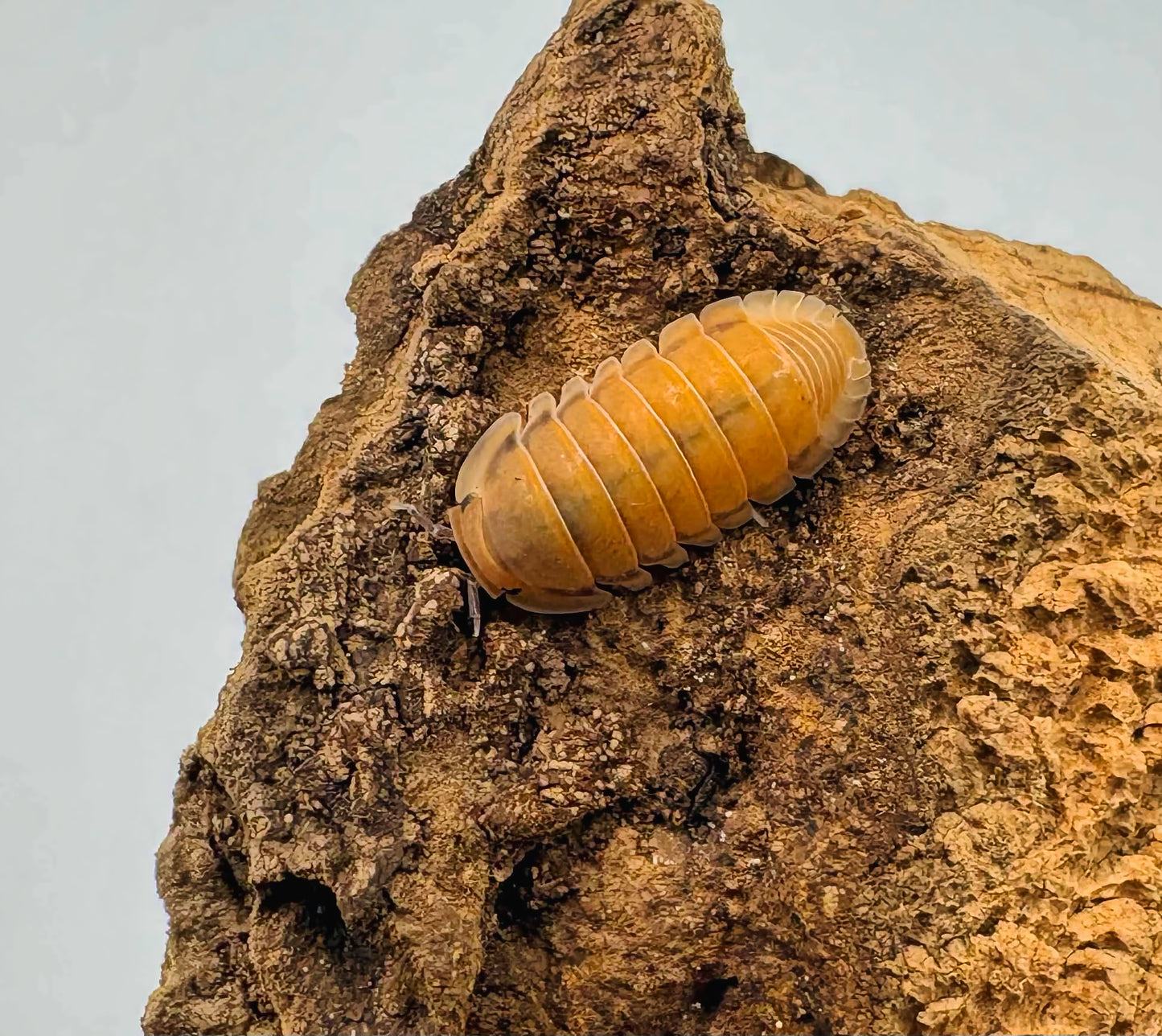
Cubaris sp "Red Pak Chong"
Cubaris sp "Red Pak Chong" is a beautiful species originating from Thailand and should not be confused with the more widely known Cubaris sp. "Pak Chong". Despite what some sources suggest, Red Pak Chong is not a colour morph of Pak Chong, but a distinct species collected from an entirely different locality. It is admired for its warm reddish-brown to orange colouration, often complemented by soft peach highlights that give each individual a rich, glowing appearance. The species takes its name from the Pak Chong district of Thailand, where it was first discovered.
My "Red Pak Chongs" are also spitting out full orange colourations of this species!
These isopods are captive-bred (CB).
Care Information
- Size: Mixed sizes.
- Diet: Rotting hardwood, leaf litter (oak, beech, maple, chestnut, Asian species), and lichen form the staple diet. Supplement regularly with calcium (cuttlefish bone, limestone, or powdered calcium carbonate), protein-rich treats (fish flakes, shrimp pellets) and vegetables (squash, carrot, zucchini, or sweet potato).
- Temperature: 20–26 °C.
- Humidity: 70-80%. Requires a high humidity like most Thai species. Maintain a moist/dry gradient: one side humid with moss or damp substrate, the other drier. Mist lightly or use a dropper every week to maintain stability without waterlogging.
- Ventilation: Provide good cross-ventilation to prevent stagnation, while keeping humidity stable.
- Substrate: Substrate minimum ~5cm deep mix, organic soil, flake soil, rotting wood, sphagnum moss, and leaf litter. Add cork bark and hardwood pieces for shelter.
- Enclosure: 3L Braplast tub or larger. For growing colonies 5L and 11L tubs may be more suitable.
Isopods are shipped securely in ventilated tubs with damp moss for safe travel.
Note: If you are interested in larger quantities than those listed, or want any advise, please get in contact!
Species Info
 Thailand
 Cubaris
 "Red Pak Chong"
 Mixed sizes
 20 - 26 °C
 70 - 80%
 Moderate-High
Buy Now
Couldn't load pickup availability
Cubaris sp "Red Pak Chong"
Cubaris sp "Red Pak Chong" is a beautiful species originating from Thailand and should not be confused with the more widely known Cubaris sp. "Pak Chong". Despite what some sources suggest, Red Pak Chong is not a colour morph of Pak Chong, but a distinct species collected from an entirely different locality. It is admired for its warm reddish-brown to orange colouration, often complemented by soft peach highlights that give each individual a rich, glowing appearance. The species takes its name from the Pak Chong district of Thailand, where it was first discovered.
My "Red Pak Chongs" are also spitting out full orange colourations of this species!
These isopods are captive-bred (CB).
Care Information
- Size: Mixed sizes.
- Diet: Rotting hardwood, leaf litter (oak, beech, maple, chestnut, Asian species), and lichen form the staple diet. Supplement regularly with calcium (cuttlefish bone, limestone, or powdered calcium carbonate), protein-rich treats (fish flakes, shrimp pellets) and vegetables (squash, carrot, zucchini, or sweet potato).
- Temperature: 20–26 °C.
- Humidity: 70-80%. Requires a high humidity like most Thai species. Maintain a moist/dry gradient: one side humid with moss or damp substrate, the other drier. Mist lightly or use a dropper every week to maintain stability without waterlogging.
- Ventilation: Provide good cross-ventilation to prevent stagnation, while keeping humidity stable.
- Substrate: Substrate minimum ~5cm deep mix, organic soil, flake soil, rotting wood, sphagnum moss, and leaf litter. Add cork bark and hardwood pieces for shelter.
- Enclosure: 3L Braplast tub or larger. For growing colonies 5L and 11L tubs may be more suitable.
Isopods are shipped securely in ventilated tubs with damp moss for safe travel.
Note: If you are interested in larger quantities than those listed, or want any advise, please get in contact!